

The Independent Investigative Mechanism for Myanmar (IIMM) says it has gathered evidence indicating that Myanmar’s military has deliberately targeted civilians in airstrikes and committed patterns of unlawful detention, torture and sexual violence.
In its 2026 annual report, released on Aug. 11, the U.N.-mandated investigative body said military airstrikes and other alleged crimes against civilians increased in the period leading up to elections completed in January this year and continued after the vote.
The report covers the IIMM’s investigations and activities from July 1, 2025, to June 30, 2026.
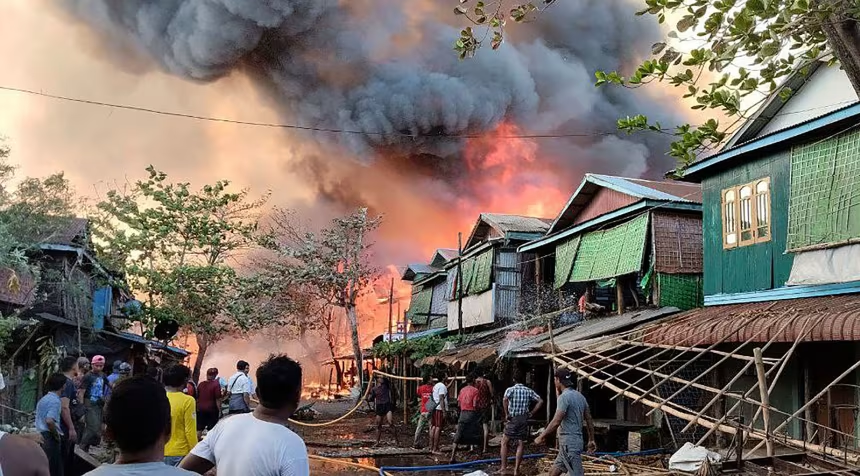
Investigators examined airstrikes on civilian locations including homes, schools, hospitals, religious buildings and camps sheltering internally displaced people, according to the report.
The IIMM said Myanmar’s military has increasingly used paramotors and drones alongside conventional aircraft, reducing the time civilians have to detect incoming attacks, flee or seek shelter.
The Mechanism said it had also identified some of the military units allegedly responsible for attacks on civilians.
Nicholas Koumjian, head of the IIMM, said the evidence collected by investigators showed the devastating impact the alleged crimes had inflicted on people’s lives and underlined the urgent need to hold perpetrators accountable.
The IIMM had already said in January that its evidence showed civilians were being deliberately or indiscriminately attacked in homes, hospitals and schools, while detainees had been subjected to torture and sexual and gender-based violence.
Detention, Torture and Sexual Violence
The 2026 report said investigators had collected extensive evidence of unlawful imprisonment, torture and sexual violence in detention facilities operated by Myanmar’s military authorities.
The IIMM also investigated arrests linked to a law enacted in 2025 that criminalised criticism of the military-organised election.
According to the report, some people faced sentences of up to 20 years in prison or the death penalty, including for comments posted on social media criticising the election.
Most of the evidence collected by the Mechanism concerns alleged crimes committed by Myanmar’s military and security forces and affiliated militias, the report said.
However, investigators are also examining allegations of atrocities committed by armed groups fighting the military. The IIMM has previously stressed that its investigations extend to alleged serious crimes committed by all sides to the conflict.
More Than 1,600 Sources
The Mechanism said its investigations were based on information obtained from more than 1,600 sources, including testimony from more than 750 witnesses.
Investigators also analysed photographs, videos, audio recordings, documents, maps, satellite and other geospatial imagery, social media posts and forensic evidence.
The IIMM said it continues to share evidence and analysis relating to crimes against the Rohingya with the International Criminal Court (ICC) and judicial authorities in Argentina.
It is also responding to requests for assistance from other judicial authorities investigating crimes committed in Myanmar since the February 2021 military takeover.
The Mechanism has additionally shared evidence and analysis for proceedings between The Gambia and Myanmar at the International Court of Justice (ICJ), where judges are considering whether Myanmar violated its obligations under the Genocide Convention during the military’s 2016 and 2017 operations against the Rohingya.
The IIMM was established by the U.N. Human Rights Council in 2018 to collect, preserve and analyse evidence of the most serious international crimes and violations of international law committed in Myanmar since 2011, and to prepare material that can be used in criminal prosecutions.